


How CardioMEMS HF System Remote PA Pressure Monitoring Works
How does sensor implantation and PA pressure monitoring work?
The CardioMEMS™ HF System provides remote pulmonary artery (PA) pressure monitoring for heart failure using a wireless sensor. Permanently implanted in the distal pulmonary artery via right heart catheterization, the sensor continuously measures PA pressure changes—a surrogate for fluid retention and worsening heart failure—enabling remote patient monitoring and early clinical intervention.
How does the data reach clinicians?
Patient-initiated sensor readings are wirelessly transmitted to a secure remote monitoring platform for clinicians to access and review.
How PA pressure monitoring enables earlier intervention
Directly monitoring PA pressure alerts you if a patient's heart failure is worsening and allows you to intervene earlier, adjusting medication or making other treatment changes, often before a patient experiences any symptoms.
Clinical Resources for Patient Selection
Use these resources to provide your patients with an overview of the CardioMEMS HF System and to identify those who may be appropriate candidates.

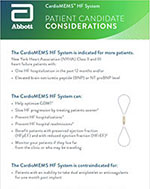
Get Daily PA Pressure Trends Remotely with CardioMEMS HF System
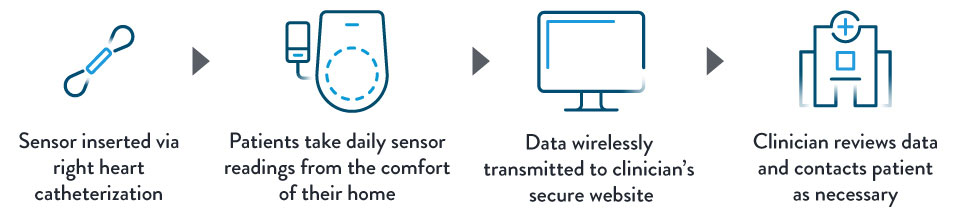
The CardioMEMS HF System streamlines outpatient monitoring by combining an implantable sensor measuring PA pressures with secure, cloud-based data review for clinicians.
- Implantation: The PA Sensor is inserted via right heart catheterization—no battery or lead replacement needed.
- Daily Readings: Patients take daily PA pressure readings from home using a portable reader.
- Data Analysis: Readings automatically transmit to Merlin.net™ Patient Care Network (PCN) HF Portal, where you access organized PA pressure trends and alerts for timely clinical decisions.
- Clinical Benefits: This workflow supports proactive heart failure management and reduces the burden of frequent in-office visits, keeping patients connected to their care team between visits.
CardioMEMS HF System Components
The CardioMEMS HF System integrates five key components: the PA sensor, delivery catheter, hospital system, the reader, and Merlin.net PCN HF Portal to enable remote pulmonary artery pressure monitoring and continuous heart failure management.
PA Sensor
The CardioMEMS™ PA Sensor is implanted into the patient's pulmonary artery during right heart catheterization. About the size of a paperclip, it measures PA pressure changes to guide heart failure management.

Delivery Catheter
Advanced over a guidewire during implant, the Delivery Catheter positions the Sensor into the pulmonary artery.

Hospital System
The CardioMEMS™ Hospital System is used during implant and when patients are in the hospital to complete the implant and pairing process, as well as take subsequent PA pressure readings. After gathering patient and PA pressure data, it connects to Merlin.net PCN HF Portal with a secure, direct data transmission.

Reader
The CardioMEMS™ HERO Device is an easy-to-use,1 next-generation CardioMEMS reader that allows your patient to conveniently1 take and send PA pressure readings. The HERO Device is 60% lighter* and smaller than the previous generation reader.2 It allows them to take a fast reading that takes less than one minute on average.1**
Merlin.net PCN HF Portal
A remote monitoring platform that organizes PA pressure data into clear, actionable information. The portal supports:
- Data Transmission: Daily PA pressure readings are automatically and securely sent from the CardioMEMS reader to the Merlin.net PCN HF Portal
- Clinician Dashboard: Access organized trend data, alerts, and historical pressure measurements
- Actionable Insights: Portal highlights patient status changes to guide timely therapy adjustments
- EMR Integration: Supports integration with major electronic medical record systems to help streamline documentation and workflow

Stay up to date on the leading hemodynamic monitoring platform for your patients with heart failure

*Including travel case
**Does not include boot up time
References:
- Abbott data on file, based on internal validation studies with representative users. Results may vary.
- Abbott data on file.



MAT-2625987 v16.0