


Don't Compromise, Take Command
The market-leading Hi-Torque Command™ 14 family of workhorse guide wires, designed for access, cross and device delivery in demanding CLTI procedures.
Proven Unique Design Elements of Hi-Torque Command™ 14 Guide Wire
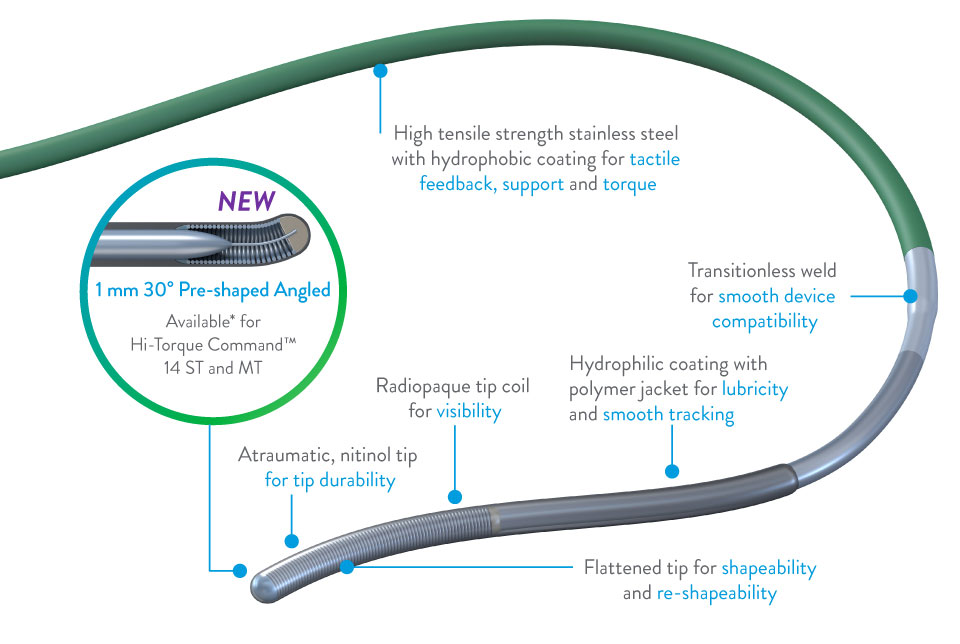
Hi-Torque Command™ 14 Family is now available with enhanced design features.
Confident Crossing and Superior Device Delivery1
- New higher tip load designs for ease of lesion crossing1
- High support profiles and shorter taper length options for diverse clinical needs1
- Easy access in challenging procedures with short access-to-lesion distances*
Controlled Prolapsing and Easy Navigation
Hi-Torque Command 14 ST/MT
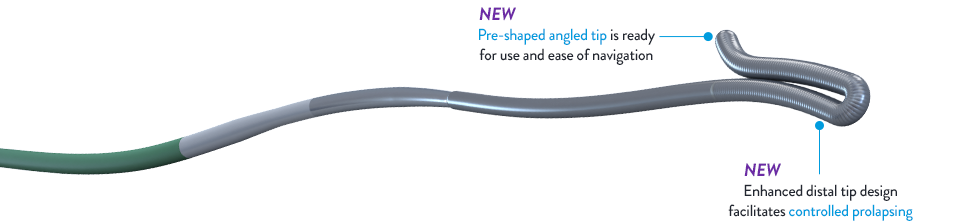
- Enhanced distal tip designed to form a short and tight loop that facilitates controlled prolapsing
- 1 mm 30° pre-shaped angled tip is for maneuverability1 and to facilitate navigation2 with control3 through tortuous anatomy
Superb Flexibility and Tip Durability
- Flattened tip provides flexibility to shape and reshape efficiently
- Durable nitinol tip retains shape and function throughout an entire procedure
- The Hi-Torque Command™ 14 ST/MT features a 2.5 cm radiopaque tip coil, while the Hi-Torque Command™ 14 ES comes with a 3 cm radiopaque tip coil, both designed for excellent visibility
- Hi-Torque Command™ ST/MT's pre-shaped angled tip is ready for use and to facilitate navigation and maneuverability1
Different Length and Tip Options
- Four different Tip Load Options of 2.8 g, 3.5 g, 4 g and 6 g
- Three different nitinol lengths of 10 cm, 25 cm, and 40 cm
- Four different wire support levels
- Three different wire lengths of 190 cm, 210 cm and 300 cm
- Hi-Torque Command™ 14 ST/MT Wires available in two tip-style options: pre-shaped angled tip and straight tip
* Command™ 14 ST and Command™ 14 MT
Support Profile For Hi-Torque Command™ 14 Peripheral Workhorse Guide Wires
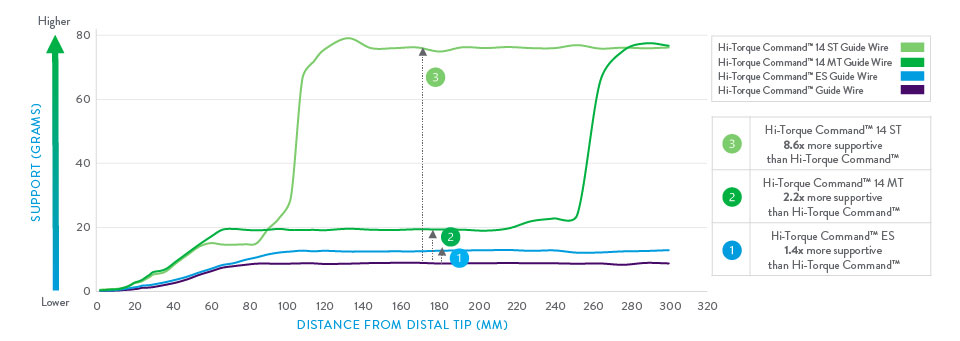
Support profile difference is calculated based on the average support levels of the wires between 150–200mm distance from the tip.
Ordering Information
| Description | Part Number | Tip Load (g) | Wire Diameter (in) | Nitinol Length | Tip Shape | Wire Length | Units Per Package |
|---|---|---|---|---|---|---|---|
| Hi-Torque Command™ 14 ST Guide Wire | 1060001 | 6 | 0.014 in | 10 cm | Straight | 210 cm | 5 |
| 1060001A | 6 | 0.014 in | 10 cm | Angled | 210 cm | 5 | |
| 1060002 | 6 | 0.014 in | 10 cm | Straight | 300 cm | 5 | |
| 1060002A | 6 | 0.014 in | 10 cm | Angled | 300 cm | 5 | |
| Hi-Torque Command™ 14 MT Guide Wire | 1060003 | 4 | 0.014 in | 25 cm | Straight | 210 cm | 5 |
| 1060003A | 4 | 0.014 in | 25 cm | Angled | 210 cm | 5 | |
| 1060004 | 4 | 0.014 in | 25 cm | Straight | 300 cm | 5 | |
| 1060004A | 4 | 0.014 in | 25 cm | Angled | 300 cm | 5 | |
| Hi-Torque Command™ ES Guide Wire | 2078174 | 3.5 | 0.014 in | 40 cm | Straight | 190 cm | 5 |
| 2078175 | 3.5 | 0.014 in | 40 cm | Straight | 300 cm | 5 | |
| Hi-Torque Command™ Guide Wire | 2078172 | 2.8 | 0.014 in | 40 cm | Straight | 190 cm | 5 |
| 2078173 | 2.8 | 0.014 in | 40 cm | Straight | 300 cm | 5 |


References
Data on file at Abbott
- Tóth, et al. "How to select a guidewire: technical features and key characteristics" Heart. 2015;101:645-652.
- Walker C. Guidewire selection for peripheral vascular interventions. Endovascular Today. 2013;5:80–3.
- Dash D. Guidewire crossing techniques in coronary chronic total occlusion intervention: A to Z. Indian Heart Journal. 2016;68:410-420.
MAT-2006300 v4.0
Important Safety Information
Hi-Torque Command™ Guide Wire

INDICATIONS FOR USE
This Hi-Torque Command™ Guide Wire is indicated to facilitate the placement of balloon dilatation catheters during percutaneous transluminal angioplasty (PTA), in arteries such as the femoral, popliteal and infra-popliteal arteries. This guide wire may also be used with compatible stent devices during therapeutic procedures.
The guide wire may also be used to reach and cross a target lesion, provide a pathway within the vessel structure, facilitate the substitution of one diagnostic or interventional device for another, and to distinguish the vasculature.
CONTRAINDICATIONS
The Hi-Torque Command™ Guide Wire is not intended for use in the coronary or cerebral vasculature.
WARNINGS
This device is not designed for use with atherectomy devices.
The lifetime of the device is the labeled shelf life. This device is designed and intended for ONE TIME USE ONLY. Do not resterilize and / or reuse. The safety and effectiveness of this device have not been established after being reprocessed for multiple uses.
Use extreme caution and careful judgement in patients for whom anticoagulation is not indicated.
If contrast agents are used, use extreme caution in patients who have had a severe reaction to contrast agents and who cannot be adequately premedicated.
Persons with known history of allergies to any of the components of this device listed below may suffer an allergic reaction to this guide wire: stainless steel, nitinol (nickel-titanium alloy), platinum-nickel alloy, polytetrafluoroethylene (PTFE) coating, Microglide™ Coating, tungsten polymer sleeve, urethane, polyvinylpyrrolidone (PVP) coating, tin-silver alloy, gold-tin alloy, and epoxy adhesive. Prior to its use on the patient, the patient should be counseled on the materials contained in the device, and a thorough history of allergies must be discussed.
This device has a hydrophilic coating at the distal end of the device that increases the lubricity of the guide wire surface for a length as specified in the table below; this device has hydrophobic coatings at the proximal end of the device that enhances the penetration capacity and provides good torque control for lengths as specified in the table below:
| Product | Type of Coating and Coating Length at the Distal End | Type of Coating and Coating Length at the Proximal End | Hydrophobic PTFE Coating Location (Proximal) |
|---|---|---|---|
| Hi-Torque Command / ES, 190 cm | PVP coating (Hydrophilic coating), 40.1 cm | Microglide Coating (Hydrophobic coating), 123.0 cm | Under Microglide Coating, 134.5 cm |
| Hi-Torque Command / ES, 250 cm | PVP coating (Hydrophilic coating), 40.1 cm | Microglide Coating (Hydrophobic coating), 183.0 cm | Under Microglide Coating, 193.0 cm |
| Hi-Torque Command / ES, 300 cm | PVP coating (Hydrophilic coating), 40.1 cm | Microglide Coating (Hydrophobic coating), 233.0 cm | Under Microglide Coating, 244.5 cm |
Refer to section PREPARATION FOR USE for further information on how to prepare and use this device to ensure it performs as intended. Failure to abide by the warnings in this labeling might result in damage to the device coating, which may necessitate intervention or result in serious adverse events.
Carefully observe the instructions under “Do Not” and “Do” below. Failure to do so may result in vessel trauma, guide wire damage, guide wire tip separation, or stent damage. If resistance is observed at any time, determine the cause under fluoroscopy and take remedial action as needed. Use the most suitable guide wire for the lesion being treated.
Do Not:
- Push, auger, withdraw, or torque a guide wire that meets resistance.
- Torque a guide wire if the tip becomes entrapped within the vasculature.
- Allow the guide wire tip to remain in a prolapsed condition.
- Deploy a stent such that it will entrap the wire between the vessel wall and the stent.
Do:
- Advance or withdraw the guide wire slowly.
- Use the radiopaque marker of the interventional device to confirm position.
- Examine the tip movement under fluoroscopy before manipulating, moving, or torquing the guide wire.
- Observe the wire under fluoroscopy for tip buckling, which is a sign of resistance.
- Maintain continuous flush while removing and reinserting the guide wire to prevent air from entering the catheter system. Perform exchanges slowly to prevent air entry and / or trauma.
- When reintroducing the guide wire, confirm that the interventional device tip is free within the vessel lumen and that the tip is parallel to the vessel wall.
- Use extreme caution when moving a guide wire through a non-endothelialized stent, or through stent struts, into a bifurcated vessel. Use of this technique involves additional patient risks, including the risk that the wire may become caught on the stent strut.
- Consider that if a secondary wire is placed in a bifurcation branch, this wire may need to be retracted prior to stent deployment because there is additional risk that the secondary wire may become entrapped between the vessel wall and the stent.
PRECAUTIONS
Never attach the torque device to the modified portion of the proximal end of the extendable guide wire; otherwise, guide wire damage may occur, preventing the ability to attach the Abbott-compatible Guide Wire Extension.
Guide wires are delicate instruments and should be handled carefully. Prior to use and when possible during the procedure, inspect the guide wire carefully for bends, kinks, or other damage. Do not use damaged guide wires. Using a damaged guide wire may result in vessel damage and / or inaccurate torque response.
Confirm the compatibility of the guide wire diameter with the interventional device before actual use.
Refer to the indication on the label and the Instructions for Use to confirm the appropriate vasculature that this guide wire may be used in. Failure to abide by the above recommendation may result in size mismatch of blood vessel and guide wire, which can result in vessel injury, such as, but not limited to, perforation, dissection, rupture, and avulsion.
Free movement of the guide wire within the interventional device is an important feature of a steerable guide wire system because it gives the user valuable tactile information. Test the system for any resistance prior to use. Adjust or replace the hemostatic valve with an adjustable valve if it is found to inhibit guide wire movement.
It is recommended that the user determine the source of resistance, exercise caution when removing the device and / or other components as a unit, and exchange the device for a new one to complete the procedure.
Avoid abrasion of the coating. Do not withdraw or manipulate the coated guide wire through a metal cannula or sharp-edged object. Manipulation, advancement, and / or withdrawal through a metal device may result in destruction and / or separation of the outer coating, which may cause coating material to remain in the vasculature. This in turn may lead to unintended adverse events requiring additional intervention.
After use, this product may be a potential biohazard. Handle and dispose of it in accordance with accepted medical practice and applicable local, state, and federal laws and regulations.
Do not soak the device for longer than 4 hours when the device is not in use. Avoid pre-soaking devices for longer than instructed, as this may impact the coating performance.
When wet, a hydrophilic coating increases the lubricity of the guide wire surface.
The coating swells when exposed to aqueous media; however, this does not have any impact on device use.
The integrity and performance of the device coating can be negatively impacted by preparation with incompatible media or solvents. Please take note of the following important recommendations:
- Avoid wiping the device with dry gauze as this may damage the device coating.
- Avoid excessive wiping of the coated devices.
- Avoid using alcohol, antiseptic solutions, or other solvents to pre-treat the device because this may cause unpredictable changes in the coating which could negatively affect the safety and performance of the guide wire.
One or more components of this device may contain the following substance defined as CMR 1B in a concentration above 0.1% weight by weight: Cobalt; Chemical Abstracts Service (CAS) No. 7440-48-4; EC No. 231-158-0. Current scientific evidence supports that medical devices manufactured from stainless steel alloys containing cobalt do not cause an increased risk of cancer or adverse reproductive effects.
The safety and effectiveness of this Hi-Torque Command™ Guide Wire have not been established in the pediatric population.
ADVERSE EVENTS
Potential adverse events associated with use of this device may include the following but not limited to:
- Allergic reaction or hypersensitivity to latex, contrast agent, anesthesia, device materials, and drug reactions to anticoagulation, or antiplatelet drugs
- Vascular access complications which may require transfusion or vessel repair, including:
- Bleeding (ecchymosis, oozing, hematoma, hemorrhage, retroperitoneal hemorrhage)
- Arteriovenous fistula, pseudoaneurysm, aneurysm, dissection, perforation / rupture, and laceration
- Embolism (air, tissue, plaque, thrombotic material, or device)
- Target artery complications which may require additional intervention, including:
- Total occlusion or abrupt closure
- Arteriovenous fistula, pseudoaneurysm, aneurysm, dissection, perforation / rupture
- Embolism (air, tissue, plaque, thrombotic material, or device)
- Artery or stent thrombosis
- Stenosis or restenosis
- Vessel spasm
- Claudication
- Venous thromboembolism (including pulmonary embolism)
- Hypotension / hypertension
- Peripheral nerve injury, neuropathy
- Other ischemic conditions / infarct
- Tissue / organ ischemia
- Tissue necrosis
- Ulcer
- Acute limb ischemia
- Infection – local and systemic (including post-procedural)
- Abscess
- Sepsis / infection including bacteremia / cellulitis / septicemia
- Contrast-induced renal insufficiency or renal failure
- Death
MAT-2678993 v1.0
Hi-Torque Command™ 14 ST Guide Wire
Hi-Torque Command™ 14 MT Guide Wire
INDICATIONS FOR USE
The Hi-Torque Command™ 14 ST Guide Wire and Hi-Torque Command™ 14 MT Guide Wire are indicated to facilitate the placement of balloon dilatation catheters during percutaneous transluminal angioplasty (PTA), in arteries such as the femoral, popliteal and infra-popliteal arteries. The guide wires may also be used with compatible stent devices during therapeutic procedures.
The guide wires may also be used to reach and cross a target lesion, provide a pathway within the vessel structure, facilitate the substitution of one diagnostic or interventional device for another, and to distinguish the vasculature.
CONTRAINDICATIONS
The Hi-Torque Command™ 14 ST Guide Wire and Hi-Torque Command™ 14 MT Guide Wire are not intended for use in the coronary or cerebral vasculature.
WARNINGS
This device is not designed for use with atherectomy devices. The safety and effectiveness of the use of the Hi-Torque Command™ 14 ST Guide Wire and Hi-Torque Command™ 14 MT Guide Wire with atherectomy devices are not established.
Use the guide wire prior to the “Use-by date” specified on the package. This device is designed and intended for ONE TIME USE ONLY. Do not resterilize and / or reuse. The safety and effectiveness of this device have not been established after being reprocessed for multiple uses.
Use appropriate anticoagulation per standard of care. Use extreme caution and careful judgement in patients for whom anticoagulation is not indicated.
If contrast agents are used, use extreme caution in patients who have had a severe reaction to contrast agents and who cannot be adequately premedicated.
Persons with a known history of allergies to any of the components of this device listed below may develop an allergic reaction to this guide wire: stainless steel, nitinol (nickel-titanium alloy), platinum-nickel alloy, polytetrafluoroethylene (PTFE) coating, silicone-based hydrophobic coating, tungsten polymer sleeve, urethane, polyvinylpyrrolidone (PVP) coating, tin-silver alloy, gold-tin alloy, and epoxy adhesive. Prior to its use on the patient, the patient should be counseled on the materials contained in the device, and a thorough history of allergies must be discussed.
This device has a hydrophilic coating at the distal end of the device and hydrophobic coatings at the proximal end of the device that increases the lubricity of the guide wire surface for lengths as specified in the table below:
| Product | Type of Coating and Coating Length at the Distal End | Type of Coating and Coating Length at the Proximal End | Hydrophobic PTFE Coating Location (Proximal) |
|---|---|---|---|
| Hi-Torque Command 14 ST, 210 cm | PVP Coating (Hydrophilic coating), 10 cm | Microglide Coating (Hydrophobic coating), 182 cm | Under Microglide Coating, 184 cm |
| Hi-Torque Command 14 ST, 300 cm | PVP Coating (Hydrophilic coating), 10 cm | Microglide Coating (Hydrophobic coating), 264.5 cm | Under Microglide Coating, 276 cm |
| Hi-Torque Command 14 MT, 210 cm | PVP Coating (Hydrophilic coating), 25 cm | Microglide Coating (Hydrophobic coating), 167 cm | Under Microglide Coating, 169 cm |
| Hi-Torque Command 14 MT, 300 cm | PVP Coating (Hydrophilic coating), 25 cm | Microglide Coating (Hydrophobic coating), 249.5 cm | Under Microglide Coating, 261 cm |
Refer to section PREPARATION FOR USE for further information on how to prepare and use this device to ensure it performs as intended. Failure to abide by the warnings in this labeling might result in damage to the device coating, which may necessitate intervention or result in serious adverse events.
Carefully observe the instructions under "Do Not" and "Do" below. Failure to do so may result in vessel trauma, guide wire damage, guide wire tip separation, or stent damage. If resistance is observed at any time, determine the cause under fluoroscopy and take remedial action as needed. Use the most suitable guide wire for the lesion being treated.
Do Not:
- Push, auger, withdraw, or torque a guide wire that meets resistance.
- Torque a guide wire if the tip becomes entrapped within the vasculature.
- Deploy a stent such that it will entrap the wire between the vessel wall and the stent.
Do:
- Advance or withdraw the guide wire slowly.
- Use the radiopaque marker of the interventional device to confirm position.
- Examine the tip movement under fluoroscopy before manipulating, moving, or torquing the guide wire.
- Observe the wire under fluoroscopy for tip buckling, which is a sign of resistance.
- Maintain continuous flush while removing and reinserting the guide wire to prevent air from entering the catheter system. Perform exchanges slowly to prevent air entry and / or trauma.
- When reintroducing the guide wire, confirm that the interventional device tip is free within the vessel lumen and that the tip is parallel to the vessel wall.
- Use extreme caution when moving a guide wire through a non-endothelialized stent, or through stent struts, into a bifurcated vessel. Use of this technique involves additional patient risks, including the risk that the wire may become caught on the stent strut.
- Consider that if a secondary wire is placed in a bifurcation branch, this wire may need to be retracted prior to stent deployment because there is additional risk that the secondary wire may become entrapped between the vessel wall and the stent.
PRECAUTIONS
The Hi-Torque Command™ 14 ST and MT Guide Wire Family has distal ends of varying stiffness. Operate these guide wires carefully so as to not injure the blood vessels, observing the information in these instructions. The higher torque performance, stiffer distal ends, and / or higher advancement force may present a higher risk of perforation or injury than a guide wire with a more pliable distal end. Therefore, use the guide wire with the least stiff distal end that will treat the lesion, and use extreme care to minimize the risk of perforation or other damage to blood vessels.
Guide wires are delicate instruments and should be handled carefully. Prior to use and when possible during the procedure, inspect the guide wire carefully for bends, kinks, or other damage. Do not use damaged guide wires. Using a damaged guide wire may result in vessel damage and / or inaccurate torque response.
Confirm the compatibility of the guide wire diameter with the interventional device before actual use.
Refer to the indication on the label and the Instructions for Use to confirm the appropriate vasculature that this guide wire may be used in. Failure to abide by the above recommendation may result in size mismatch of blood vessel and guide wire, which can result in vessel injury, such as, but not limited to, perforation, dissection, rupture, and avulsion.
Free movement of the guide wire within the interventional device is an important feature of a steerable guide wire system because it gives the user valuable tactile information. Test the system for any resistance prior to use. Adjust or replace the hemostatic valve with an adjustable valve if it is found to inhibit guide wire movement.
It is recommended that the user determine the source of resistance, exercise caution when removing the device and / or other components as a unit, and exchange the device for a new one to complete the procedure.
Avoid abrasion of the coating. Do not withdraw or manipulate the coated guide wire through a metal cannula or sharp-edged object. Manipulation, advancement, and / or withdrawal through a metal device may result in destruction and / or separation of the outer coating, which may cause coating material to remain in the vasculature. This in turn may lead to unintended adverse events requiring additional intervention.
Do not soak the device for longer than 4 hours when the device is not in use. Avoid pre-soaking devices for longer than instructed, as this may impact the coating performance.
When wet, a hydrophilic coating increases the lubricity of the guide wire surface.
The coating swells when exposed to aqueous media; however, this does not have any impact on device use.
The integrity and performance of the device coating can be negatively impacted by preparation with incompatible media or solvents. Please take note of the following important recommendations:
- Avoid wiping the device with dry gauze as this may damage the device coating.
- Avoid excessive wiping of the coated devices.
- Avoid using alcohol, antiseptic solutions, or other solvents to pre-treat the device because this may cause unpredictable changes in the coating which could negatively affect the safety and performance of the guide wire.
Attempting to alter the shape of devices by bending, twisting, or similar methods beyond instructed methods may compromise the coating integrity, and that damage to the coating may not always be noticeable to the naked eye.
One or more components of this device may contain the following substance defined as CMR 1B in a concentration above 0.1% weight by weight: Cobalt; Chemical Abstracts Service (CAS) No. 7440-48-4; EC No. 231-158-0. Current scientific evidence supports that medical devices manufactured from stainless steel alloys containing cobalt do not cause an increased risk of cancer or adverse reproductive effects.
The safety and effectiveness of the Hi-Torque Command™ 14 ST Guide Wire and Hi-Torque Command™ 14 MT Guide Wire have not been established in the pediatric population.
ADVERSE EVENTS
Potential adverse events associated with use of this device may include the following but not limited to:
- Allergic reaction or hypersensitivity to latex, contrast agent, anesthesia, device materials, and drug reactions to anticoagulation, or antiplatelet drugs
- Vascular access complications which may require transfusion or vessel repair, including:
- Bleeding (ecchymosis, oozing, hematoma, hemorrhage, retroperitoneal hemorrhage)
- Arteriovenous fistula, pseudoaneurysm, aneurysm, dissection, perforation / rupture, and laceration
- Embolism (air, tissue, plaque, thrombotic material, or device)
- Target artery complications which may require additional intervention, including:
- Total occlusion or abrupt closure
- Arteriovenous fistula, pseudoaneurysm, aneurysm, dissection, perforation / rupture
- Embolism (air, tissue, plaque, thrombotic material, or device)
- Artery or stent thrombosis
- Stenosis or restenosis
- Vessel spasm
- Claudication
- Venous thromboembolism (including pulmonary embolism)
- Hypotension / hypertension
- Peripheral nerve injury, neuropathy
- Other ischemic conditions / infarct
- Tissue / organ ischemia
- Tissue necrosis
- Ulcer
- Acute limb ischemia
- Infection – local and systemic (including post-procedural)
- Abscess
- Sepsis / infection including bacteremia / cellulitis / septicemia
- Contrast-induced renal insufficiency or renal failure
- Death
MAT-2407512 v2.0