


Why remote hemodynamic management of heart failure patients?
Heart failure signs and symptoms, such as swelling and shortness of breath, have poor sensitivity to detect congestion at an early stage.5,6
Early detection of pulmonary artery (PA) pressure allows identification of congestion weeks before the onset of symptoms and overt compensation.7,8,9
PA Pressure monitoring with the CardioMEMS HF System can lead to improved heart failure outcomes and reduced mortality
Reduced Mortality
A recent real-world study of 9,579 Medicare patients implanted with the CardioMEMS HF System showed both baseline pulmonary artery diastolic (PAD) pressures and improved PAD within the first 90 days post-implant as strongly predictive of 2-year survival.2

Even small improvements in PA pressures had a positive impact on mortality. Each 1 mmHg decrease in baseline PAD, or change in PAD from baseline to 90 days, is associated with a 3% decrease in mortality risk at 2 years.2
Reduced Heart Failure Hospitalization
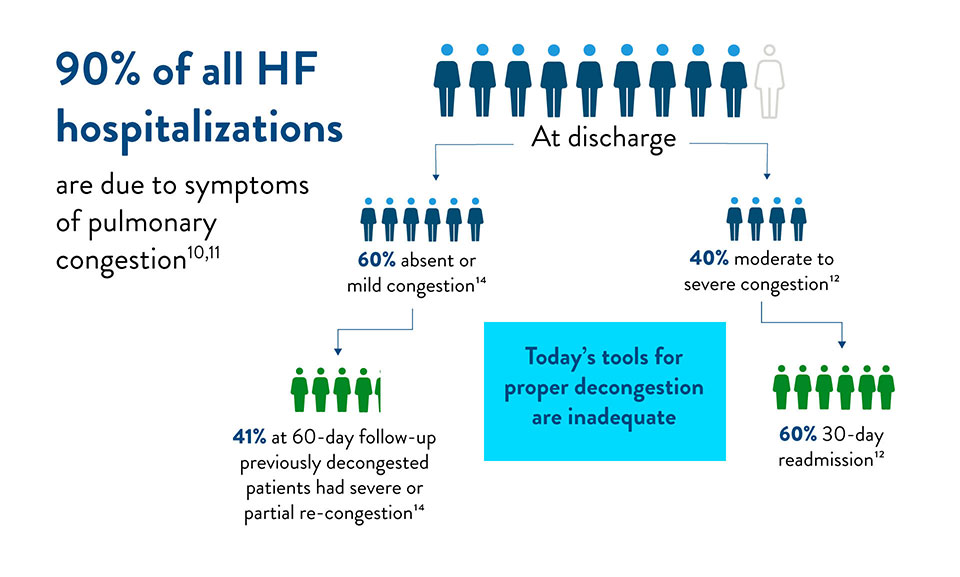
90% of heart failure hospitalizations are due to symptoms of pulmonary congestion.10,11 Of those patients admitted, many develop severe or partial re-congestion within 60 days of discharge12 or must be readmitted within 30 days.
Clinical trial data has shown management with the CardioMEMS HF System leads to a reduction in heart failure hospitalizations by 44%.13

Improved Quality of Life
The presymptomatic data provided by the CardioMEMS HF System allow for proactive changes in medical therapy before heart failure symptoms appear,12 leading to a 44% reduction in heart failure hospitalizations and a 7-point improvement in patient-reported quality of life.12


Transforming Heart Failure Care: Insights from a Community Cardiologist on Early Intervention and CardioMEMS
In this episode of The Cardiac Wire Show, Dr. Marc Atzenhoefer shares his experience using the CardioMEMS HF System technology to improve patient care through earlier intervention.
“Let’s move heart failure care into the 21st century.” -Marc Atzenhoefer, MD / Froedtert & Medical College of Wisconsin
Clinical evidence shows how and why early intervention with hemodynamic insights makes a difference for patients
Congestion leads to a majority of heart failure hospitalizations10,11
Today’s tools for proper decongestion are inadequate. In fact, 90% of all heart failure hospitalizations are due to symptoms of pulmonary congestion.10,11 As a result, earlier intervention, including proper dosing strategies and lifestyle adjustments, is critical for avoiding decompensation events.
Presymptomatic data enables earlier HF intervention
In a clinical trial meta-analysis of implantable hemodynamic monitoring (IHM) devices, hemodynamic-guided management in patients with HFrEF was associated with a 25% reduction in overall mortality.1

The presymptomatic insights enabled by hemodynamic-guided heart failure management allow you to intervene before decompensation events (including hospitalization) occur – whether by adjusting diuretics and other medications, or recommending lifestyle adjustments for your patients.
Determine if your heart failure patients are indicated for the CardioMEMS HF System with our Patient Indication Quiz.

References
- Lindenfeld J, Costanzo MR, Zile MR, et al., on behalf of the GUIDE-HF, CHAMPION, and LAPTOP-HF Investigators. Meta-Analysis of Implantable Hemodynamic Monitors for HFrEF. Implantable Hemodynamic Monitors Improve Survival in Patients With Heart Failure and Reduced Ejection Fraction. J Am Coll Cardiol. 2024;83:682-694.
- Zalawadiya S, Abraham J, Rathman L, et al. Early Reduction of Pulmonary Artery Pressures Is Associated With Improved Mortality Among Medicare Beneficiaries With Heart Failure. JACC Heart Fail. 2025;13(10):102589. doi:10.1016/j.jchf.2025.102589.
- Givertz MM, Stevenson LW, Costanzo MR, et al., on behalf of the CHAMPION Trial Investigators. Pulmonary artery pressure–guided management of patients with heart failure and reduced ejection fraction. J Am Coll Cardiol. 2017;70:1875-86.
- Abraham J, Bharmi R, Jonsson O, et al. Association of ambulatory hemodynamic monitoring with clinical outcomes in a concurrent matched cohort analysis. JAMA Cardiology. 2019;4(6):556-563.
- McDonagh TA, Metra M, Adamo M, Gardner RS, Baumbach A, Böhm M, et al. 2021 ESC Guidelines for the diagnosis and treatment of acute and chronic heart failure: Developed by the Task Force for the diagnosis and treatment of acute and chronic heart failure of the European Society of Cardiology (ESC). With the special contribution of the Heart Failure Association (HFA) of the ESC. Eur J Heart Fail. 2022; 24: 4–131. https://doi.org/10.1002/ejhf.2333
- Gheorghiade M, Follath F, Ponikowski P, Barsuk JH, Blair JEA, John G. Assessing and grading congestion in acute heart failure: A scientific statement from the Acute Heart Failure Committee of the Heart Failure Association of the European Society of Cardiology and endorsed by the European Society of Intensive Care Medicine. Eur J Heart Fail. 2010; 12: 423–433. https://doi.org/10.1093/eurjhf/hfq045.
- Zile MR, Bennett TD, St John Sutton M, Cho YK, Adamson PB, Aaron MF, et al. Transition from chronic compensated to acute decompensated heart failure: Pathophysiological insights obtained from continuous monitoring of intracardiac pressures. Circulation. 2008; 118: 1433–1441. https://doi.org/10.1161/CIRCULATIONAHA.108.783910
- Adamson PB, Abraham WT, Bourge RC, Costanzo MR, Hasan A, Yadav C, et al. Wireless pulmonary artery pressure monitoring guides management to reduce decompensation in heart failure with preserved ejection fraction. Circulation: Heart Failure. 2014; 7(6):935-944.
- Stevenson LW, Zile M, Bennett TD, Kueffer FJ, Jessup ML, Adamson P, et al. Chronic ambulatory intracardiac pressures and future heart failure events. Circ Heart Fail. 2010; 3: 580–587. https://doi.org/10.1161/CIRCHEARTFAILURE.109.923300
- Adams KF Jr, et al. Characteristics and outcomes of patients hospitalized for heart failure in the United States: rationale, design, and preliminary observations from the first 100,000 cases in the Acute Decompensated Heart Failure National Registry (ADHERE). Am Heart J. 2005 Feb;149(2):209-16.
- Krum H, Abraham WT. Heart failure. Lancet. 2009;373(9667):941-955. doi:10.1016/S0140-6736(09)60236-1.
- Felker GM, Lee KL, Bull DA, et al. Diuretic strategies in patients with acute decompensated heart failure. N Engl J Med. 2011;364(9):797-805. doi:10.1056/NEJMoa1005419.
- Brugts, J et al. Remote haemodynamic monitoring of pulmonary artery pressures in patients with chronic heart failure (MONITOR-HF): a randomised clinical trial. The Lancet. May 20, 2023. https://doi.org/10.1016/S0140-6736(23)00923-6
- Lala A, et al. The Tides of Congestion during and after Hospitalization for Acute Decompensated Heart Failure. J Cardiac Fail. 2013;19(8):S81. DOI: 10.1016/j.cardfail.2013.06.260.
MAT-2514267 v1.0